Haunting Encounters
The Fortress Built to Keep Something From Getting Out
A prisoner was promised his freedom if he agreed to be lowered into a deep hole that appeared to have no bottom. Nobody knew what was down there but the people gathered around the opening believed it was evil.
According to the legend, the man disappeared into the darkness on a rope. Moments later, his screams echoed up from below, and the men hurried to pull him back.
When he reached the surface, his hair had turned white and his face looked as though he had aged thirty years. He couldn't explain what he had seen and died two days later.
The place was Houska, a remote hilltop in what is now the Czech Republic. A medieval castle would later stand above the opening that the locals came to believe was the entrance to Hell.
The Hole Beneath the Hill
Long before the fortress was built, people living near Houska told stories about a deep opening in the ground. It was said to be so dark that nobody could see the bottom, and unsettling sounds were often heard from its depths.
The surrounding forest had its own reputation. There were stories of winged creatures coming out of the hole at night, along with things that looked part human and part animal.
Some described a headless horse wandering among the trees. Others spoke of screams coming from underground and shadowy creatures that disappeared whenever anyone approached.
Eventually, the villagers tried to fill the hole with stones. The work took three years because the opening seemed to swallow everything thrown into it. Even after the chasm was covered, people feared that something might still find a way out.
A Castle in the Middle of Nowhere
Houska Castle stands roughly 47 kilometres north of Prague, surrounded by forests and rocky hills in the Kokořín region. Its origins go back to the 13th century, during the reign of the Bohemian king Přemysl Otakar II.
Its location is one of the things that makes the building so unusual. The castle stood far from major trade routes and didn't guard an important border crossing. There was also no large settlement nearby that needed protecting.
Access to water was limited, which would have been a serious problem if the fortress came under siege. For a building designed to defend against an attacking army, it was a strange place to establish a stronghold.
One of Houska's most famous stories concerns the direction of its defences. People have long claimed that parts of the castle were arranged to prevent something inside from escaping, rather than keeping attackers out.
The building was altered several times over the centuries, including major Renaissance renovations. Much of its present appearance comes from those changes, although parts of the original medieval structure remain.
Among the oldest surviving rooms is a Gothic chapel, and this is where the castle's haunting takes an even stranger turn.
The Chapel Above the Darkness
The chapel contains medieval wall paintings, including religious figures and strange creatures. Among them are images associated with St. Michael battling a dragon and a female centaur carrying a bow.
The chapel was built directly over the sealed opening. Its thick stone walls and religious decorations were meant to protect the people living above.
There is also talk of hidden passages and chambers beneath Houska. Some tell of strange remains found in sealed rooms, while others describe underground spaces that nobody wanted to explore.
The castle's history also includes tales of a mysterious figure who appears without warning. Unlike the creatures associated with the pit, this visitor is said to resemble a monk.
The Faceless Monk
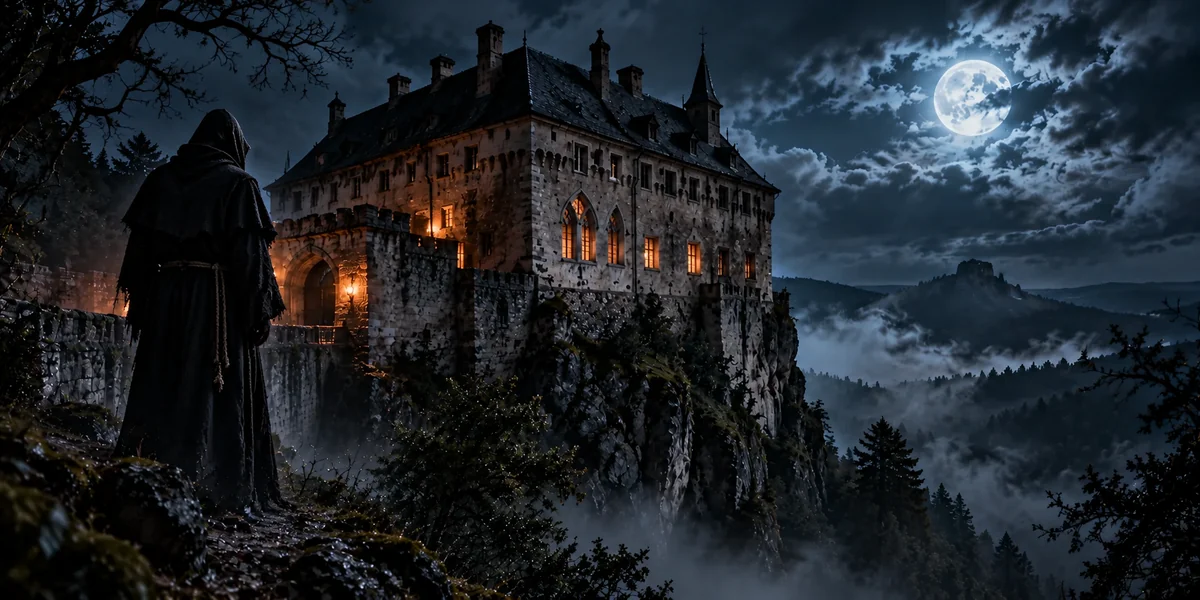
The monk is described as a man dressed in a long black robe, with a hood pulled over his head. When people look beneath it, they cannot see a face.
He is said to appear in the castle's corridors and around the grounds, sometimes standing motionless before disappearing. Local stories describe him as a guardian watching over the place where the underground opening was sealed.
The castle has another legend involving a Swedish man named Oronto, who was said to have occupied Houska during the 17th century. He became obsessed with black magic and carried out secret experiments while searching for a way to live forever.
Oronto frightened the surrounding villagers. Eventually, two hunters entered the castle and killed him, bringing his experiments to an end.
Houska passed through the hands of several noble families over the following centuries. Its rooms were rebuilt and adapted for different owners, but the stories about what lived beneath the building never disappeared.
During the Second World War, the castle entered another dark period.
The Castle Under Nazi Occupation
German forces occupied Houska during the war and remained there until 1945. The castle's official history records that it was used to store Jewish and Masonic books.
Over time, it became connected to secret experiments and strange activity inside the building. These included unexplained lights, strange noises and attempts to harness the castle's supernatural powers.
The darkest versions claim that the Germans wanted to discover what was hidden beneath the chapel. Stories about occult experiments became part of the castle's folklore, adding another chapter to its already ominous reputation.
After the war, Houska was used for other purposes, including storage for the State Library. The property eventually returned to the descendants of Josef Šimonek, who had purchased it in 1924.
In 1999, the castle opened to the public for the first time in its history. Visitors could finally walk through its medieval rooms, examine the old paintings and explore the building that had inspired so many frightening stories.
What Still Lies Beneath Houska
Today, Houska Castle attracts visitors interested in its architecture and the legends surrounding it. The medieval chapel remains one of its main attractions, along with the old rooms and corridors that have changed surprisingly little over the centuries.
For anyone who knows the legends, walking through the building can be an unsettling experience. The stone passages are quiet, the rooms are dim, and the surrounding forest makes the castle feel isolated.
The story of the prisoner remains one of the scariest parts of Houska's history. He went down into the darkness expecting to earn his freedom and came back so terrified that he couldn't even tell anyone what had happened.