Haunting Encounters
At Midnight, the Headless Coach Reaches Sampson Cross and Explodes
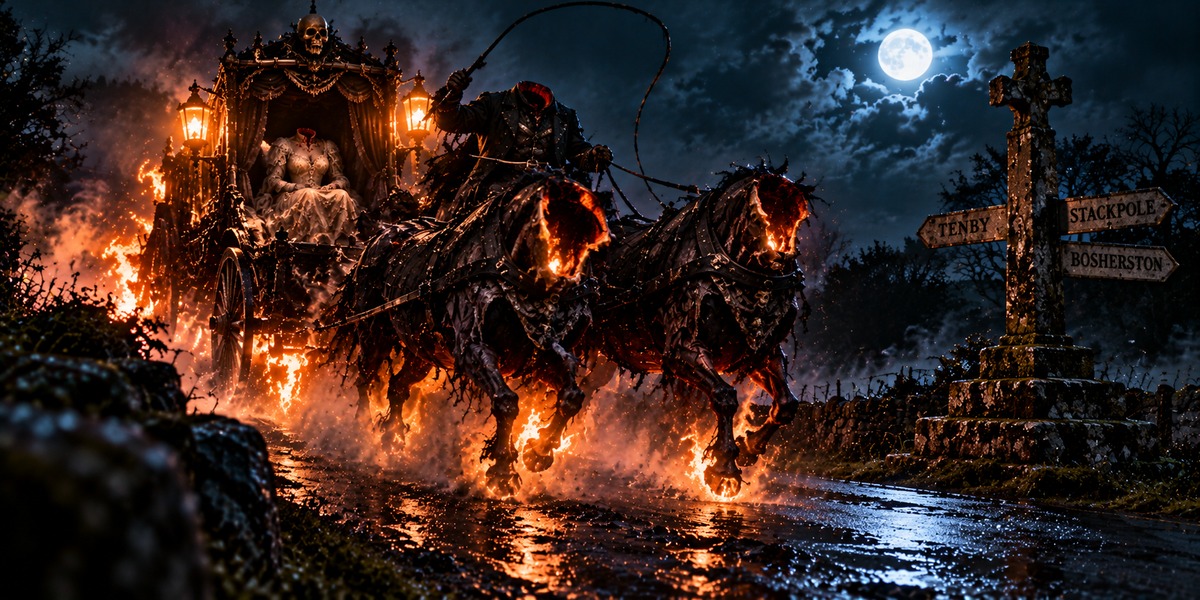
Travellers heading home from market in southern Wales had good reason to feel nervous when they approached Sampson Cross after dark. According to an old local legend, a mysterious carriage travelled the road at night, and nobody wanted to meet it.
The story had been passed around Pembrokeshire for generations. It involved a wealthy woman, a coach travelling from Tenby and a rather unfortunate problem with everyone riding in it.
None of them had heads.
A Crossroads With a Terrifying Reputation
Sampson Cross was a place where four roads met in the countryside of southern Pembrokeshire. In the days when people travelled by horse and carriage, the roads could be lonely places after sunset, especially for farmers returning from market.
The local legend became familiar enough that travellers knew which stretch of road to watch as they approached the crossroads. It was particularly unsettling because the carriage supposedly followed the same route every night.
One of the earliest detailed written versions appeared in Stranger Than Fiction, a book published in 1911 by Mary L. Lewes. She had collected ghost stories and strange experiences from around Wales, often speaking directly with people who knew the local traditions.
For the Sampson Cross story, her source was a clergyman who lived nearby. He described a haunting that had apparently been associated with the road for many years.
A Coach Full of Headless Travellers
According to Lewes, the mysterious passenger was a woman known as Lady Z., who had supposedly lived during the seventeenth century. Her memorial was said to stand in a nearby church.
Every night, the woman was believed to travel from Tenby, about ten miles away, in a horse-drawn coach. The horses had no heads, the coachman had no head, and neither did the woman sitting inside.
There was nothing vague about the route. The carriage always headed toward Sampson Cross, and local tradition gave it a very specific time to arrive.
Midnight.
The Coach Disappeared in an Explosion
When the carriage reached the crossroads, something extraordinary was supposed to happen. Instead of continuing along the road, the entire procession vanished in a burst of flames accompanied by a tremendous explosive noise.
The horses, coachman, passenger and carriage all disappeared together. There was no overturned vehicle or wreckage left behind in the story, and the coach would make the same journey again the following night.
For anyone travelling that road after dark, the legend offered a frightening possibility. Another carriage approaching from behind might not contain ordinary travellers at all.
The Clergyman’s Horse Was Afraid
The clergyman who told Lewes the story had an experience of his own that he found difficult to explain. He owned an elderly horse that was normally calm and dependable, even when travelling along unfamiliar roads.
But whenever he drove past Sampson Cross after dark, the animal reportedly became nervous and startled at something. During daylight, the same horse behaved perfectly normally at the exact spot.
The clergyman found this especially curious because his horse was not generally frightened by ordinary roadside sights or noises. Whatever bothered it seemed to be associated with the crossroads at night.
He also told Lewes that some local people believed the haunting had already been stopped. According to that version, the ghostly traveller had been sent into the waters of a nearby lake, where she was supposed to remain.
The Woman Eventually Got a Name
As the story continued to be told, the woman in the carriage became known as Lady Mathias. Later versions connected her with Stackpole Court, a grand country house that once stood on one of Pembrokeshire’s largest estates.
Stackpole Court had hundreds of rooms and was home to generations of wealthy landowners. The mansion was eventually demolished in the 1960s, although much of the surrounding estate survived.
In the Lady Mathias version, the phantom coach travelled between Tenby and Sampson Cross by way of Stackpole. The woman was still headless, and so were her coachman and horses.
Lewes’s earlier account had called the passenger Lady Z., so the two versions weren’t identical. But the later story added something especially entertaining: an explanation for how the haunting finally came to an end.
A Vicar Came Up With an Unusual Solution
According to the later tradition, several attempts were made to stop Lady Mathias from travelling the roads, but none succeeded. Eventually, the Vicar of St Petrox decided to give the troublesome spirit a job. He ordered her to empty the Bosherston Lily Ponds using a cockle shell as a ladle.
It was a ridiculous assignment, which was exactly the idea. A cockle shell could hold only a tiny amount of water, and the ponds were enormous. Emptying them one shellful at a time would take an impossibly long time.
Similar tricks appeared in other old ghost stories. Instead of confronting a spirit directly, someone would give it a task so difficult that it could never finish and return to causing trouble.
In this version, Lady Mathias disappeared after receiving her assignment, and the headless coach was never seen again.
The Ponds Are Still There
Today, the Bosherston Lily Ponds are one of the best-known features of the Stackpole estate. Visitors come to walk beside the water, cross the old stone bridges and admire the water lilies that cover parts of the lakes in summer. The ponds are now protected as part of a nature reserve, and the surrounding countryside attracts walkers and wildlife enthusiasts throughout the year.
There is no sign of anyone attempting to empty them with a cockle shell, but the strange punishment remains part of the local folklore.
It may be one of the most imaginative methods ever devised for keeping an unwanted ghost occupied.