Haunted Places
The Village Where the Devil Seemed to Spread From House to House
On March 15, 1857, ten-year-old Péronne Tavernier collapsed at school in the mountain village of Morzine, in the French Alps. Earlier that day, she had witnessed the frightening rescue of a young girl from a rushing river.
At first, her family thought she was ill. But Péronne began experiencing strange attacks, sometimes falling into a trance and behaving as though she had no control over her own body.
Soon, another girl began suffering similar episodes. The children were frightened, their families didn’t know what to do, and rumors started spreading through the village.
People began whispering about demonic possession.
The Attacks Spread Through the Village
Morzine was a small, isolated community surrounded by steep mountains. In 1857, reaching the nearest large town could mean hours of difficult travel along narrow paths. Religion was an important part of everyday life, and when the girls began behaving in ways their families couldn’t explain, some villagers believed evil spirits were responsible.
Over the following months, more girls and young women began experiencing violent attacks. Witnesses described screaming, convulsions and sudden changes in personality. Some women reportedly spoke in unfamiliar voices, cursed at priests and claimed that demons were controlling their bodies.
One of the strangest features was how strongly religious activities seemed to affect them. A woman who appeared calm at home might suddenly begin screaming when brought into a church or confronted with a priest.
Families tried prayers, blessings and exorcisms. But the incidents continued, and the number of people affected kept growing.
By November 1857, contemporary accounts recorded twenty-seven sufferers. What had begun with two young girls was becoming a serious problem for the entire community.
Doctors Arrived With Different Ideas
Local doctor Tavernier prepared a medical report in August 1857, only months after the first incidents. Other doctors and government officials soon became involved.
They encountered women who sometimes appeared perfectly healthy between attacks. During an episode, however, they might collapse, struggle violently or shout things their families found deeply upsetting.
Some doctors described the condition as hysteria, a broad medical term used at the time for nervous disorders. Others believed the attacks were connected to the villagers’ fears and the growing expectation that another person would become possessed.
The families weren’t necessarily convinced. They had watched their daughters suffer, and many believed the girls were being tormented by something far more frightening than an ordinary illness.
By 1861, one contemporary account put the number of sufferers at 120. Later historical research recorded as many as 200 people affected during the wider outbreak.
Leaving Morzine Sometimes Made the Attacks Stop
Doctors and officials noticed something unusual when some of the women were taken away from Morzine. Patients sent to other towns or hospitals sometimes improved while they were away. But when they returned home, the terrifying episodes could begin again.
This pattern became one of the most puzzling parts of the whole affair. Why would a woman suffer violent attacks in Morzine but appear calmer somewhere else?
The authorities tried separating sufferers, hoping to prevent the attacks from spreading through families and groups of friends. Some were sent to Annecy, Chambéry and other nearby towns.
These measures brought mixed results. Certain women improved, while others continued having episodes despite being removed from the village. Meanwhile, the people who remained in Morzine were living with the constant possibility that a daughter, sister or neighbor might suddenly begin screaming and convulsing.
The French Government Sent in Soldiers
There was another complication for the authorities. When the disturbances began in 1857, Savoy belonged to the Kingdom of Sardinia. In 1860, the region became part of France.
The French government inherited a village already several years into its frightening ordeal. Officials sent medical specialists to investigate, including Augustin Constans, an inspector of mental hospitals. He believed the attacks formed a kind of epidemic and recommended separating affected women and reducing the excitement surrounding religious ceremonies.
The government also brought in police and soldiers to help maintain order. Some clergy were replaced, public gatherings were restricted, and officials tried to discourage the repeated exorcisms that had become part of village life.
For a while, things seemed to improve. But Morzine wasn’t finished with its strange affliction.
The Bishop’s Visit Turned Into Chaos
In the spring of 1864, Bishop Charles-Marie Magnin of Annecy arranged to visit Morzine. By then, the disturbances had been going on for seven years, and the villagers hoped his arrival might finally bring relief.
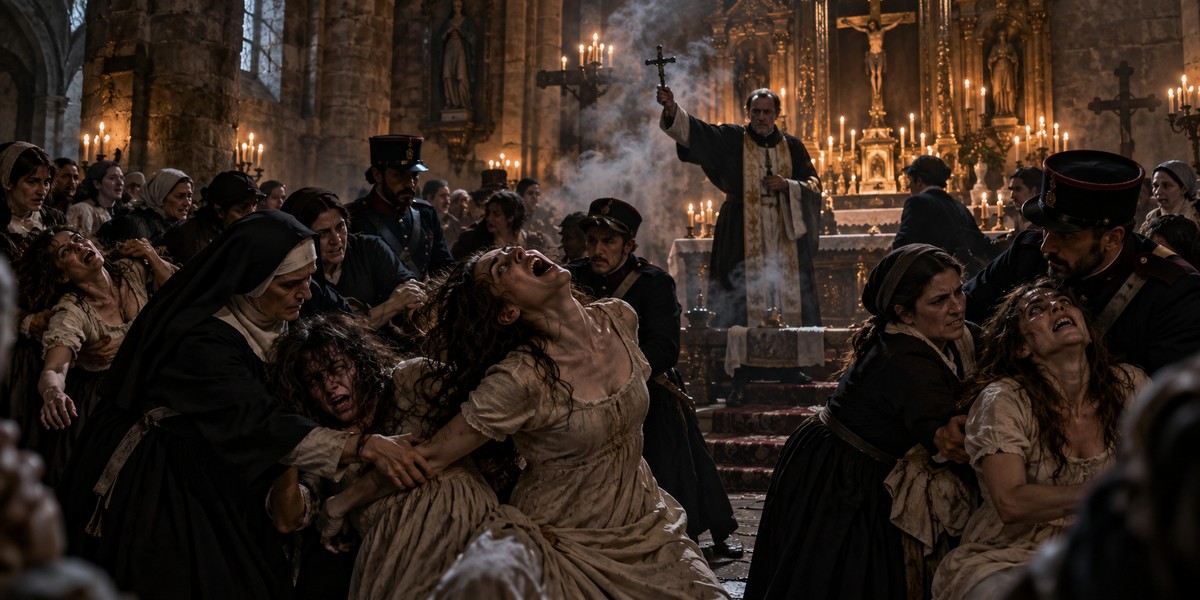
The bishop was scheduled to conduct religious ceremonies, including confirmation, and many residents gathered at the church. On April 30, as he approached the village, women reportedly began suffering violent attacks. Some screamed and struggled while others had to be restrained by relatives or attendants.
The situation became even worse when the bishop entered the church. Contemporary witnesses described women collapsing, shouting insults and making terrible noises during the religious ceremony.
Some reportedly rushed toward the bishop, screaming at him as he tried to continue. Others struggled so violently that people nearby had difficulty holding them.
The bishop was shaken by what he witnessed. In his later account, he compared the terrible scene to something out of hell. The visit, which everyone had hoped would restore peace, had instead produced one of the largest and most frightening outbreaks Morzine had experienced.
French authorities responded by sending more troops into the area. Soldiers were stationed around the village as officials worked to separate sufferers and restore order.
The Village Slowly Returned to Normal
The disturbances continued after the bishop’s visit, although the most dramatic public attacks gradually became less frequent. Doctors kept treating patients, officials maintained restrictions, and the community slowly moved away from the atmosphere of fear that had surrounded the earlier years.
By around 1870, the widespread outbreaks had largely ended. Some individuals continued experiencing symptoms, but Morzine was no longer reporting the enormous gatherings of screaming and convulsing women that had once drawn investigators from across France.
The events had lasted roughly thirteen years, leaving behind medical reports, government correspondence and eyewitness accounts. They also inspired decades of arguments among doctors, religious leaders and researchers.
When the bishop returned to Morzine in 1870, there was no repeat of the chaos that had greeted him six years earlier.