Haunting Encounters
Twenty Years Before Salem, Elizabeth Knapp Said the Devil Was Inside Her
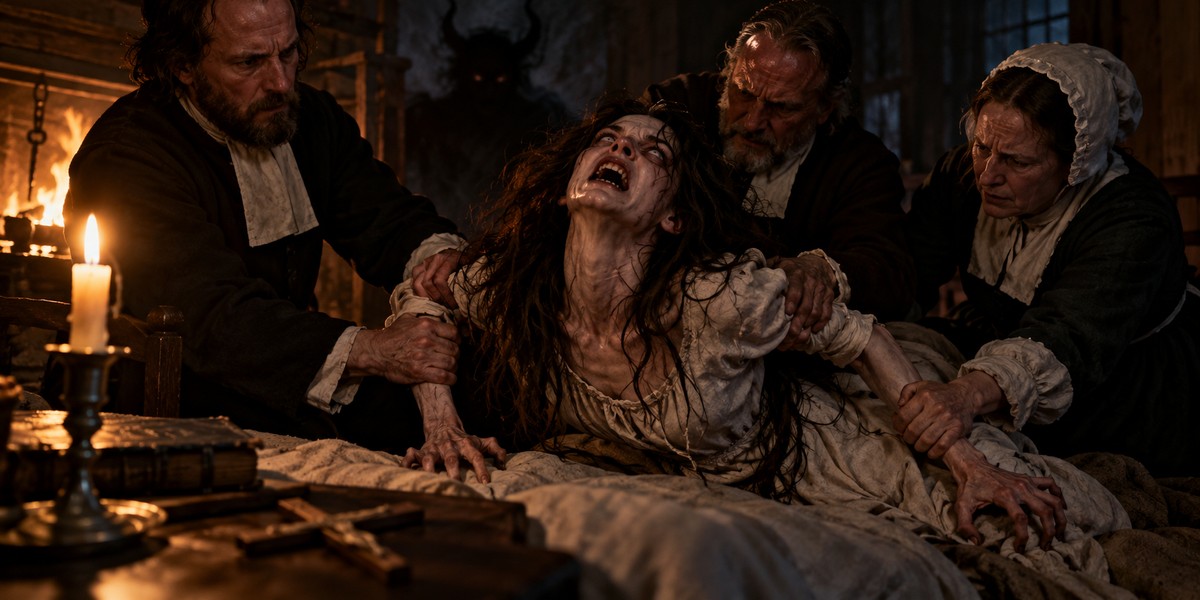
Elizabeth Knapp was sitting beside the fire when she suddenly cried out in pain. First she grabbed her legs, then her chest, and finally her throat, screaming that something was strangling her.
The people around her had no idea what was happening. Elizabeth had been behaving strangely for days, but this was much more frightening than anything they’d seen before.
It was October 30, 1671, in Groton, Massachusetts. Elizabeth was sixteen years old and worked as a servant in the home of Reverend Samuel Willard. Before long, the minister would become convinced that something terrifying had entered his household.
The Trouble Started With Sudden Screams
For about two weeks before the incident by the fire, Willard had noticed changes in Elizabeth’s behaviour. She would suddenly shriek for no apparent reason and then refuse to explain what had frightened her.
Sometimes she burst into uncontrollable laughter, even falling to the floor. When Willard asked whether she was feeling ill, she insisted she was fine.
On October 31, Elizabeth went into the cellar and screamed that she could see two people down there. Members of the household searched the room, but nobody else was present.
Later that evening, after most of the family had gone to bed, Elizabeth was reportedly thrown violently onto the floor. She began convulsing so badly that people rushed to keep her from falling into the fire.
The attacks continued over the following days. During some episodes, three or four people reportedly struggled to restrain her.
She Said the Devil Had Been Visiting Her
As the household searched for answers, Elizabeth began telling a disturbing story. She claimed the Devil had been appearing to her for three years, long before she arrived at Willard’s home.
According to her account, he had promised her money, fine clothes, freedom from hard work and the chance to travel around the world. For a teenage servant who spent her days doing household chores, those offers would have been tempting.
But Elizabeth said the promises came with terrible demands. She claimed the Devil wanted her to hurt people, including members of Willard’s family, and had tried to persuade her to enter into an agreement with him.
She also described a book containing the names of people who had supposedly made similar agreements. Some of those names belonged to women living nearby.
That frightened Willard. In seventeenth-century New England, an accusation of witchcraft could destroy someone’s life, and Elizabeth’s claims threatened to draw other people into the affair.
A Doctor Was Called to the House
Willard didn’t rely entirely on prayer. He also arranged for a doctor to examine Elizabeth and try to find out why she was suffering such violent attacks.
The doctor initially believed she had a physical illness and prescribed treatments that included bloodletting and medicines intended to clear her system. For a short time, Elizabeth seemed to improve.
But the attacks returned, and some became even more severe. One episode in late November reportedly continued for nearly two days, leaving Elizabeth exhausted and barely responsive afterward.
The doctor eventually told Willard that he believed demonic possession was involved. The minister had already been considering the same possibility, but he continued questioning Elizabeth carefully and recording what happened.
A Voice Began Speaking Through Her
In December, the household witnessed something even more unsettling. According to Willard’s account, Elizabeth began speaking in a low, unfamiliar voice during some of her attacks.
The voice reportedly insulted the minister, calling him a rogue and accusing him of lying to the people of Groton. Willard believed something was speaking through Elizabeth rather than the girl herself.
He brought a light closer to examine her face. He later wrote that he couldn’t see her lips moving, even though words were coming from her throat, which appeared unusually swollen.
Willard challenged the voice, addressing it as Satan. What followed was a heated exchange in which the voice claimed to be more powerful than the minister and refused to stop insulting him.
Other people in the room began arguing with it too. Willard eventually ordered them to stop, worried that the confrontation was getting out of control.
Elizabeth Changed Her Story
The minister was especially troubled by Elizabeth’s claims about making an agreement with the Devil. At one point, she said she had given him blood and signed her name in his book.
A few days later, she insisted that parts of her earlier confession weren’t true. She said some of the frightening things she’d described had been more like dreams, and she begged Willard to believe her.
Willard wasn’t convinced. He continued asking questions, trying to work out why her story kept changing and whether someone else was controlling what she said.
Elizabeth’s condition continued into January 1672. Sometimes she could speak normally, but at other times she became quiet or suffered attacks whenever unfamiliar people came to see her.
The Minister Kept a Detailed Record
Throughout the ordeal, Willard wrote down what he saw and what Elizabeth told him. His account included dates, descriptions of the attacks and conversations that took place inside the house.
He also resisted allowing the accusations against other women to spread. One woman had been blamed for appearing to Elizabeth in a frightening vision, but the accusation was withdrawn rather than becoming the beginning of a larger investigation.
That was an important decision. Twenty-one years later, the Salem witch trials would show how quickly accusations of invisible attacks and demonic influence could turn into prosecutions and executions.
Willard’s account survived and was later used by other ministers, including Cotton Mather, who published his own dramatic version of Elizabeth’s experiences.
Elizabeth’s Life After the Haunting
The surviving records tell us that Elizabeth eventually recovered. About three years after the events in Groton, she married a man named Samuel Scripture, and the couple went on to have children.
Her later life appears to have been fairly ordinary, with no further famous episodes of possession.
The girl who had frightened an entire household eventually settled into family life in colonial Massachusetts.