Haunting Encounters
Two Brothers Became Something Their Village Could Not Explain
The two boys were lying on their backs when their bodies began spinning so quickly that people watching compared them to turning wheels. Their limbs twisted into strange positions, and afterward, they could be left weak and exhausted for hours.
Doctors had examined the brothers, but nobody seemed able to help them. What started as an illness had become a frightening ordeal for the entire family.
In the small French village of Illfurth, people were beginning to wonder whether something far more unusual was happening to the children.
It Started With Two Sick Boys
In the autumn of 1864, nine-year-old Théobald Burner and his seven-year-old brother Joseph became ill at almost the same time. Their family lived in Illfurth, a village in Alsace, near the German border.
Their parents called for medical help. Doctors from nearby towns examined the boys, but the treatments they tried brought little improvement.
Théobald grew painfully thin, while both brothers suffered attacks that left their parents frightened and helpless. Their bodies sometimes twisted into unusual positions, their stomachs swelled, and they could become extremely agitated.
By September 1865, witnesses were reporting the alarming spinning movements. The attacks had become so frequent that caring for the brothers was taking a terrible toll on the family.
They Reacted to Religious Objects
As the illness continued, people began noticing something else. According to accounts from the time, the boys sometimes reacted violently to prayers, holy water and blessed objects.
Witnesses even claimed the brothers could sense religious items hidden from view. If someone secretly brought a blessed object into the room, the children supposedly reacted before they could have known it was there.
Their voices also frightened people. During some attacks, witnesses said the boys spoke in tones far deeper than their normal voices. At other times, they appeared to know things that nobody could explain.
The village priest, Father Charles Brey, became closely involved with the family. He began collecting accounts from witnesses and eventually came to believe the brothers were possessed by demons.
The Bishop Sent Investigators
In February 1868, Father Brey wrote to the bishop of Strasbourg, describing what had been happening in Illfurth. The bishop was reluctant to accept the priest’s explanation and wanted the situation investigated.
An early attempt at exorcism took place in 1868, but the boys’ condition continued. The following spring, church authorities sent three investigators to examine the brothers and speak with people who had witnessed their attacks.
The investigators heard reports of unusual strength, strange voices and violent reactions during prayers. After reviewing the accounts, they agreed with Father Brey’s belief that the boys were possessed.
Church authorities eventually approved formal exorcisms. The brothers would be treated separately, starting with Théobald.
Théobald Was Taken Away
In the autumn of 1869, Théobald travelled with his mother to Schiltigheim, near Strasbourg. The plan was to carry out the ceremony away from the attention surrounding the family in Illfurth.
Traditional accounts describe the boy becoming extremely agitated when preparations began. Several people reportedly had to hold him while the priests continued their prayers.
As the ceremony went on, witnesses said Théobald struggled and shouted. Eventually, after repeated prayers invoking the Virgin Mary, he became calm.
Those present believed the exorcism had worked. Théobald was said to have recovered from his ordeal, and accounts of the case describe him returning to a more ordinary life.
His younger brother, however, was still suffering. Father Brey now turned his attention to Joseph.
Joseph Was Brought to an Old Chapel
On October 27, 1869, Joseph was taken to the Burnkirch chapel outside Illfurth. The old church stood beside a cemetery and had served the surrounding community for centuries.
Father Brey led the ceremony. According to religious accounts, Joseph became violently agitated as the prayers began. He shouted, made animal-like sounds and struggled against the people holding him.
His arms and legs were reportedly tied to prevent him from hurting himself or anyone nearby. Even then, witnesses described the boy as extraordinarily difficult to restrain.
The priests continued praying and repeatedly called upon the Virgin Mary. After a long and exhausting ceremony, Joseph reportedly stopped struggling and became quiet. Witnesses said he appeared confused when he recovered, almost as though he had just awakened and didn’t understand why everyone was gathered around him.
For the Burner family, the years of frightening attacks had finally come to an end. Both boys were said to have recovered, and the people who had witnessed their ordeals believed the prayers had freed them.
The Village Built a Monument
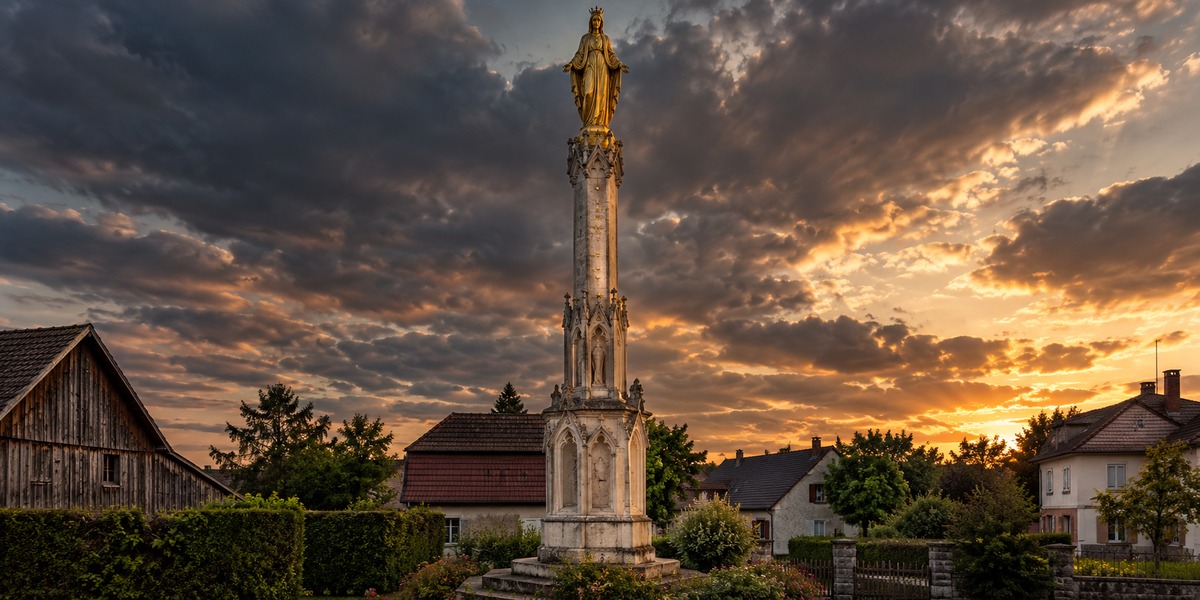
Three years later, in 1872, Illfurth erected a memorial dedicated to the brothers. Father Brey had encouraged the project, and the finished monument featured a gilded statue of the Virgin Mary above a stone base.
It was built near the family’s former home, using money raised through the sale of a booklet about the case. The villagers wanted a permanent reminder of what they believed had happened.
The inscription was written in Latin and named both Théobald and Joseph. It commemorated their deliverance in 1869 through the help of the Virgin Mary.
The memorial was erected while many of the people who had witnessed the events were still alive. For them, the story wasn’t something handed down from previous generations. They had watched it unfold.
Illfurth Still Remembers
More than 150 years later, visitors to Illfurth can still find reminders of the Burner brothers. The municipality includes the memorial and Burnkirch chapel among its historic places.
The village’s heritage walking route explains the connection between the two sites and the events of 1869. Visitors can see the old chapel where Joseph’s ceremony took place and the monument that was built a few years afterward.