Haunting Encounters
The Ghostly Nun and the Messages on Borley Rectory’s Walls
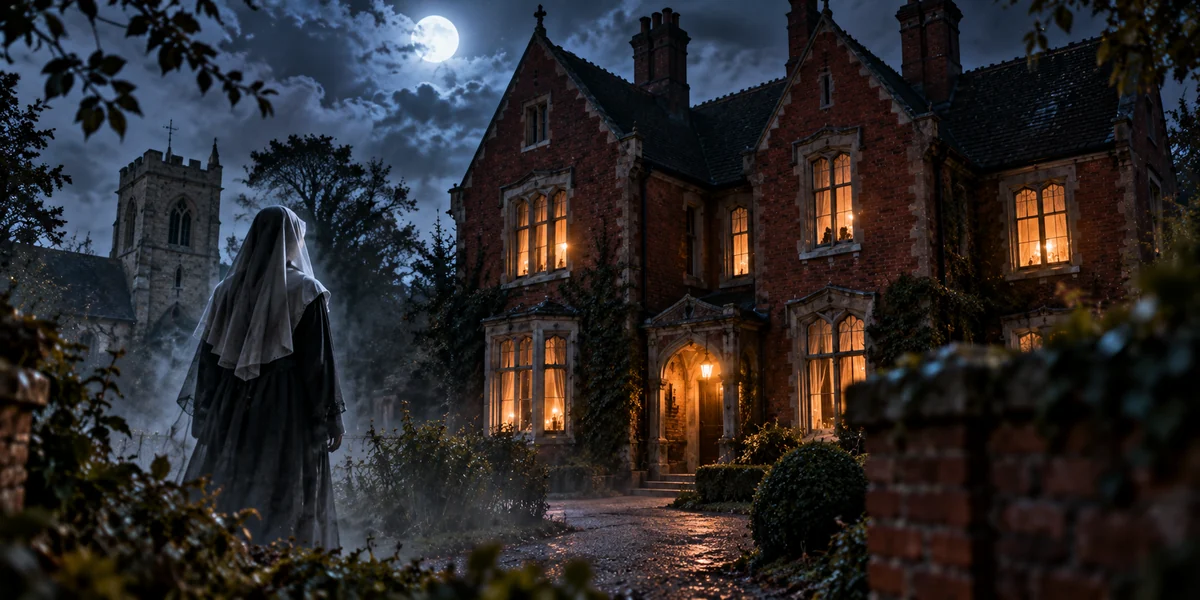
Someone was writing messages on the walls of Borley Rectory. They weren’t random scratches or meaningless marks. The words were addressed to Marianne Foyster, the woman living inside the house.
One message asked for help. Another mentioned her by name, as though whoever was writing it knew exactly who she was.
By then, the family had already endured months of strange activity. Bells rang in empty rooms, objects moved without being touched, and a woman dressed as a nun had been seen wandering through the gardens.
But the messages were different. Whatever was haunting Borley Rectory was now trying to communicate with the people who lived there.
The Woman in the Garden
Borley Rectory stood beside a small church in the Essex countryside, close to the Suffolk border. Built in the 1860s, it was a sprawling red-brick house with 23 rooms, three staircases, and long corridors connecting its many rooms.
The Reverend Henry Bull lived there with his family. Over the years, servants and visitors experienced strange sounds, footsteps in empty rooms, and doors that opened when nobody was nearby. But the most frightening encounters happened outside.
On July 28, 1900, four of Bull’s daughters were walking through the grounds when they spotted a woman dressed in what looked like a nun’s habit. She stood some distance away, her dark clothing making her easy to see against the garden, but they couldn’t make out her face.
One of the young women decided to approach her. She wanted to know who the stranger was and why she was standing there. Before she could reach her, the woman vanished.
Other people encountered the same figure, including a gardener and a local carpenter. She appeared in different parts of the grounds, always dressed in dark religious clothing. Before long, everyone was calling her the nun.
An old story offered a frightening explanation for her presence. According to local folklore, a nun had fallen in love with a monk, and the two planned to run away together.
When their relationship was discovered, the monk was executed, while the nun was sealed inside a wall and left to die. People wondered whether the woman wandering Borley’s gardens was searching for the man she’d lost.
The Bells Nobody Was Ringing
Visitors described hearing a horse-drawn carriage approaching the house, followed by the unmistakable sound of wheels and hooves. But when someone went outside, the driveway was empty.
Footsteps moved through vacant rooms, and people heard voices coming from parts of the house where nobody was standing.
In 1928, the Reverend Guy Eric Smith moved into the rectory with his wife, Mabel. They knew little about the property’s frightening history when they arrived, but it didn’t take long for them to discover why people were afraid of the place.
The old servants’ bells began ringing without anyone pulling their cords. Small stones appeared in rooms, objects disappeared, and footsteps could be heard moving through empty corridors.
Smith once heard a woman’s voice begin as a low moan before growing louder. He listened carefully, trying to understand what she was saying, but couldn’t make out the words.
The couple tried living with the disturbances, but the activity continued. In June 1929, the Daily Mirror sent a reporter to investigate. The newspaper also contacted Harry Price, a paranormal researcher who had spent years investigating haunted houses.
Price arrived with his secretary and began examining the building. During that first visit, stones were thrown, knocking sounds answered questions, and a glass candlestick broke.
News of the haunting spread quickly. People across Britain were soon reading about the strange things happening inside an old rectory in Essex.
The Smiths eventually left, but Borley Rectory wasn’t going to remain empty. Another family moved in, unaware of just how frightening their time in the house would become.
Marianne Begins Receiving Messages
In October 1930, the Reverend Lionel Foyster arrived with his wife, Marianne, and their adopted daughter, Adelaide. The disturbances started again soon after they settled into the house.
Bells rang unexpectedly, footsteps moved through empty rooms, and objects flew across the furniture. Windows broke, doors locked themselves, and bottles were thrown across rooms.
Marianne experienced some of the most frightening incidents. She was shut inside rooms, pushed by something she couldn’t see, and frightened by objects moving around her.
Lionel began keeping a diary, writing down the strange things happening to his family. But before long, he had something else to record: messages were appearing around the house.
At first, words turned up on scraps of paper. Soon, writing began appearing directly on the walls, sometimes in places the family had passed only moments earlier.
Some messages were difficult to read, while others contained recognizable words and fragments of sentences. One began with the words, “Marianne, please help get,” but stopped before the sentence was complete.
Other writing addressed her directly, asking for assistance without explaining what kind of help was needed. The family couldn’t understand who was writing the messages or what Marianne was supposed to do.
For people who knew the story of the nun, the messages were especially frightening. The old legend described a woman who had been sealed inside a wall, and now someone was asking Marianne for help from inside the very house where she lived.
Visitors came to see the disturbances for themselves. Religious figures attempted to settle the haunting, and spiritualists tried communicating with the presence, but the activity continued.
The Foysters remained at Borley until 1935, when they finally moved away. Harry Price, however, wasn’t ready to abandon the investigation.
The Nun Finally Has a Name
In 1937, Price rented Borley Rectory so he could investigate it without a family living there. He organized a group of 48 observers, including an army officer, a doctor, and an engineer.
They took turns staying inside the building, watching for strange activity and writing down what happened. Some heard footsteps or unexplained noises, while others experienced objects moving and disturbances during the night.
Price also became involved in attempts to communicate with the spirits connected to the house. During a series of séances, a name emerged: Marie Lairre.
The spirit identified herself as a French nun who had been murdered and buried at Borley. Her story closely resembled the old legend that had followed the rectory for generations, and people began connecting the woman in the garden with the name received during the séances.
Another spirit, calling itself Sunex Amures, delivered a frightening warning. Borley Rectory was going to burn, and the message even gave a specific night when the fire would happen.
That night passed without anything happening, but the warning remained part of the investigation. Less than two years later, flames engulfed the rectory.
The Night the House Burned
On February 27, 1939, fire broke out inside Borley Rectory. The owner, William Hart Gregson, had only recently moved into the property when the flames spread through the building, destroying much of the house that had frightened generations of residents.
Even during the fire, witnesses encountered something strange. People watching the blaze described seeing a woman inside the burning building, her figure appearing against the flames before disappearing from sight.
The sighting immediately brought back memories of the nun who had wandered the gardens decades earlier. Had she returned to the house one final time?
After the fire, people continued visiting the ruins. Some saw strange lights in the damaged windows, while others heard noises coming from what remained of the building.
Harry Price returned to search the property. In 1943, excavations uncovered a human jawbone and several other objects beneath the ruins, stirring fresh interest in the story of the murdered nun.
People wondered whether the discovery was connected to the woman who had wandered the gardens and pleaded for help through the messages on the walls. The mystery had followed Borley Rectory through decades of strange encounters, and now it had survived the destruction of the house itself.
The final ruins were demolished in 1944, but the stories continued. Books, documentaries, and paranormal investigations kept the haunting alive, and in October 2026, PBS revisited the case through its Monstrum series.